

May Healthcare Threat Intelligence Brief: From Cyber Risk to Operational Reality
June 15, 2026
June Healthcare Threat Intelligence Brief: The Center of Gravity Moves “Up the Stack”
July 14, 2026
Why National Internet Safety Month Demands a Structural Shift in Family Office and Institutional Security Architecture
Every June, the cybersecurity landscape undergoes a familiar ritual. National Internet Safety Month arrives, accompanied by a predictable deluge of corporate compliance checklists, baseline hygiene reminders, and consumer-focused warnings about password strength and public Wi-Fi risks. While well-intentioned, this traditional cadence addresses a reality that no longer exists for high-net-worth families, single-family offices, and specialized institutions. In an era defined by decentralized operations, deeply integrated vendor supply chains, and highly sophisticated social engineering, traditional perimeter defenses are fundamentally insufficient. True digital safety is not an HR check-the-box training exercise performed once a year; it is an active state of structural resilience.
The Structural Blind Spots
Most Organizations Miss Generalist firms and traditional custodians frequently look at internet safety through an isolated lens: protecting the network. However, modern adversaries rarely break *into* networks; they log in using compromised credentials, exploit unmonitored interpersonal vulnerabilities, or target external fragments of your operational ecosystem.
THE COMPETITIVE REALITY
Most organizations rely on an outdated “trusted vs. untrusted” paradigm. They assume that because an enterprise application, an external legal partner, or a multi-family office platform has an active contract, their access point is secure. In contrast, advanced threat actors explicitly target these adjacent trust
relationships to exploit structural fragmentation.
To move past superficial security, organizations must identify and mitigate some core structural blind spots that traditional annual audits regularly miss:
1. Fragmented Vendor Governance
A family office might have institutional-grade cybersecurity on its primary servers, but its critical data simultaneously resides with concierge medicine providers, private aviation charters, specialized tax counsels, and boutique real estate firms. Each of these endpoints solves a mere fragment of your security puzzle, leaving a structural vacuum.
2. The “Asymmetric Visibility” Deficit
Internal IT generalists are often tasked with managing day-to-day productivity platforms alongside complex defensive strategies. This creates an asymmetric gap: attackers operate 24/7 with specialized toolsets, while internal teams are constrained by standard operational hours and broad, non-specific infrastructure mandates.
The June Playbook: Structural Actions That Matter
Instead of repeating standard security awareness briefings this June, executive teams and family office leaders should use National Internet Safety Month to audit structural realities. Here is the operational playbook for institutional-grade digital defense:
I. Map the “Shadow Trust” Network
Identify every third-party entity that handles sensitive operational data, physical security details, or financial routing info. Demand verification of their around-the-clock defense architecture—not just a copy of an annual ISO certificate.
II. Enforce Out-of-Band Verification Protocols
The most dangerous threats ignore firewalls entirely, opting to impersonate principals or trusted advisors via sophisticated deepfakes and spear-phishing. Establish an unbreakable, non-digital verification protocol for all capital calls, material wire changes, and critical operational updates.
III. Eliminate the Custodian Dependency Myth
Many offices fall into a false sense of security believing that banking partners or large asset custodians maintain total defensive oversight. Custodians protect assets *within their custody*, but they do not protect your family, your communication channels, or your broader private digital footprint.
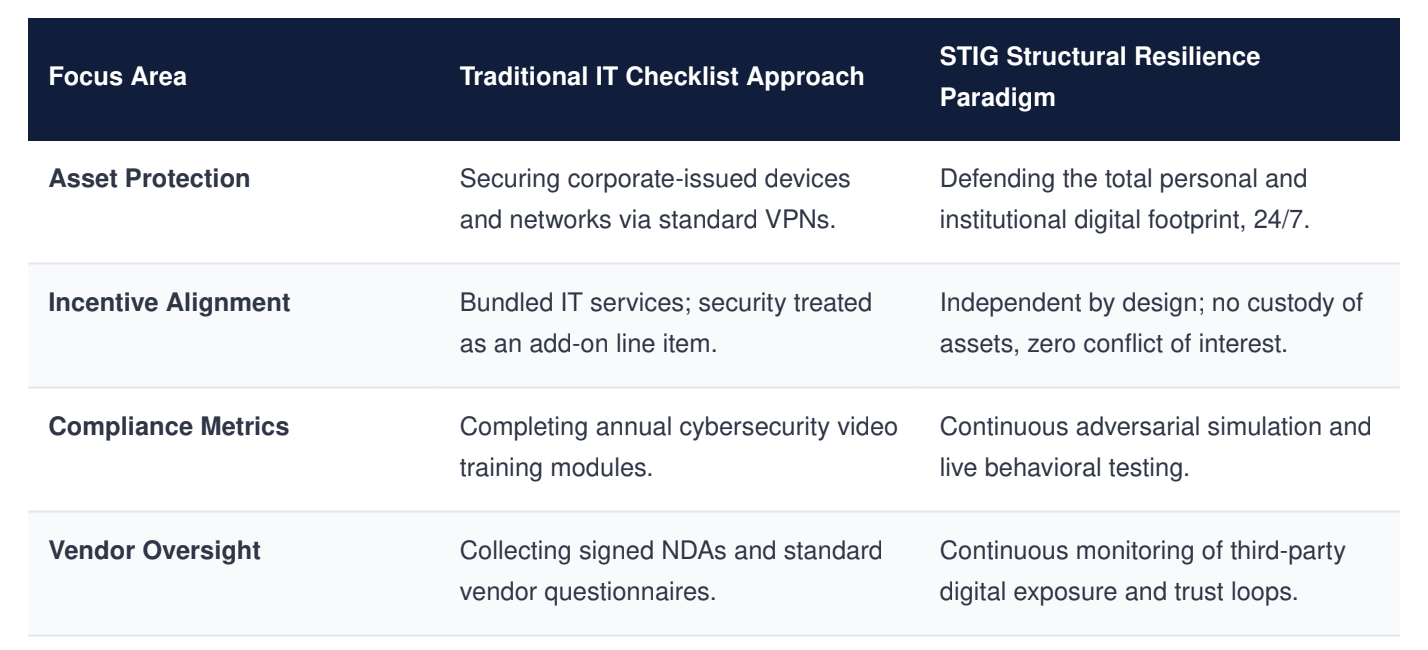
Paradigm Shift: Traditional Hygiene vs. Modern Resilience
To clarify the strategic gap between generic IT counsel and advanced asset protection, consider how traditional internet safety practices compare to a sophisticated, thought-leadership-driven model:
Conclusion: Security is Not a Shared Fragment
National Internet Safety Month serves as an excellent annual reminder, but true safety is found in the architectural choices made for the remaining eleven months of the year. Family office IT, generalist firms, and custodians each solve a fragment. None runs an around-the-clock defense on your assets. Moving forward requires moving past the perimeter. True digital sovereignty demands a partner dedicated purely to defense, built on the strict discretion governing regulated federal ecosystems, and uncompromised by competing institutional incentives.